
Read the 2026 Build the Budget Report
We saw over 2,200 resident engagements this season, beating last year by a healthy margin. This number is nearly double the first year we did this program in 2021, and the most engagement we’ve had in a Build the Budget cycle!
Read the 2026 Build the Budget Report
Every year, Build the Budget invites South Bend residents to share their thoughts on next year’s City budget. The Mayor, Common Council, City departments, and residents work together to craft a plan for city spending.
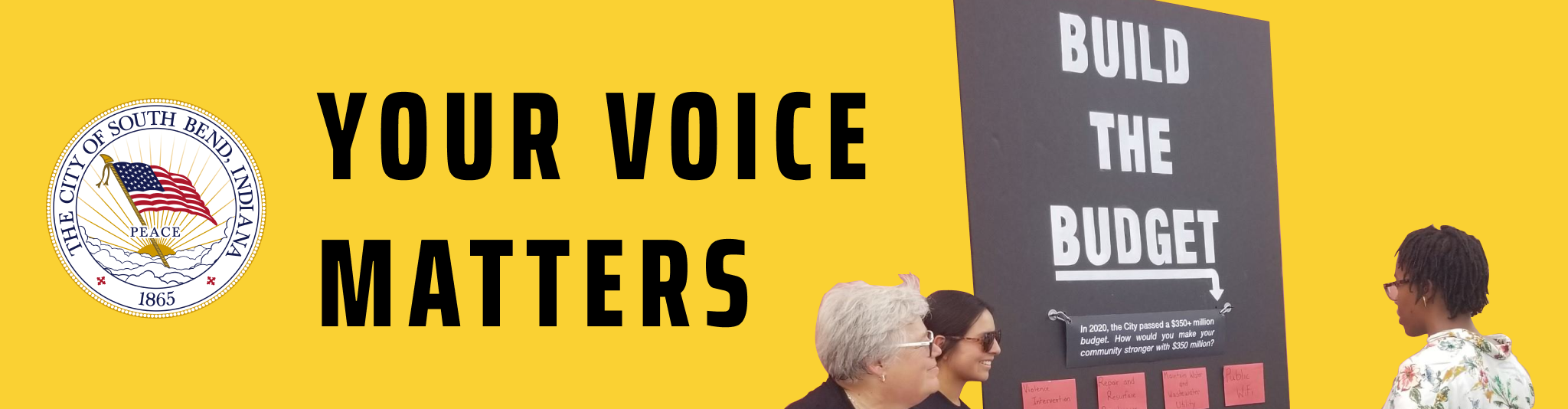
What do you care about? Streets? Public safety? Parks? Your voice matters. Build the Budget!
Introduction to the City Budget
Learn about the City budget process in this introduction video!
Attend meetings and events
Community Events
Keep an eye out for City staff members gathering feedback community events starting in August!
Upcoming Events:
- Meet the Mayor | St. Adalbert Parish | July 29, 2025 @6:00pm
- DTSB’s August First Fridays | August 1, 2025 @ 6:00pm
- SBPD National Night Out | August 5, 2025 @ 5:30pm
- DTSB Art Beat | August 9, 2025 @11:00am
- DTSB’s September First Fridays | September 5, 2025 @ 6:00pm
- Linden Ave Farmers Market | September 13, 2025 @ 10:00am
- Fusion Fest Day 1 | September 27, 2025 @12:00pm
- Fusion Fest Day 2 | September 28, 2025 @12:00pm
Mayor’s Office Events
Come talk with the Mayor’s Office to learn more about this year’s budget process!
The City of South Bend will host the next quarterly Meet the Mayor and Team South Bend event on Tuesday, July 29 from 6-8:00 pm at Saint Adalbert Parish, 2505 W Grace Street, South Bend, IN 46619.
Residents are invited to attend and have a one-on-one, 5-minute conversation with Mayor James Mueller and other city officials.
City staff and staff of other local organizations will also be in attendance.
Budget Hearings
During public budget hearings, the Mayor, City Controller, and department heads present department budgets to the Common Council. Budget hearings are held in council chambers on the 4th floor of the County-City Building unless noted otherwise. Budget hearings will commence mid-August. Come back closer to those dates for more information.
| Date | Time | Department |
| Wednesday, August 13, 2025 | 5:30 P.M. | 2026 City-Wide Budget Overview Meeting | Mayor’s Office | Diversity and Inclusion| Community Police Review Board| City Clerk | Common Council |
| Wednesday, August 20, 2025 | 6:00 P.M | Administrative Departments (Administration & Finance | Legal | Innovation & Technology) |
| Wednesday, August 27, 2025 | 6:00 P.M | Department of Community Investment (DCI) | Transpo |
| Wednesday, September 3, 2025 | 5:30 P.M. | Department of Public Works |
| Wednesday, September 10, 2025 | 6:30 P.M | Venues Parks and Arts (VPA) | Human Rights Commission (HRC) |
| Thursday, September 11, 2025 | 6:00 P.M | Police Department & Fire Department |
| Wednesday, September 17, 2025 | 6:00 P.M | Council Working Session | Budget Wrap-up and Final Questions |
| Monday, October 13, 2025 | 7:00 P.M | Vote on 2026 Budget |
Frequently Asked Questions (FAQs)
0The City’s annual budget outlines how the City will spend public funds. Residents, the South Bend Common Council, and the Mayor set strategic priorities for these funds.
The budget isn’t a mandate to spend, so the City can spend less than the budgeted amount. It establishes the legal highest amount the City can spend on various priorities. In other words, the City cannot exceed its spending budget.
The City organizes the budget into services such as fire response, police patrol, or trash pickup.
- The City develops drafts of the budget.
- The City organizes events for residents to share input on the budget. City administration also presents the budget to Common Council during public hearings.
- Common Council passes a budget ordinance for the following year.
The City categorizes spending in the budget into Baseline Spending and Strategic Spending. These categories ensure investments in the budget follow City strategic priorities
Baseline Spending
- Baseline Spending funds essential operations at the City to keep residents safe and healthy. It also includes spending that the City already committed to. Examples are servicing debt or maintaining current capital assets.
- Around 85% of the City’s budget is Baseline Spending. During the budget process, the City doesn’t question if these expenditures are necessary. Instead, the City determines the most efficient funding structure for these expenditures.
Strategic Spending
- Around 15% of the City’s budget is Strategic Spending, which supplements essential operations. Strategic Spending helps our residents not only survive but thrive in the City.
- The City determines Strategic Spending by aligning investments with City priorities. This is in contrast to Baseline Spending, which focuses on essential services.
The City generates revenue to support expenditures through tax revenue and charges for service
Tax Revenue
- Property taxes make up about 25% of all City revenue and primarily fund most core government operations. Core operations include Police, Fire, Parks, and administrative departments.
- Income taxes make up about 11% of City revenues. Income taxes primarily fund other government operations. Other operations include those from Neighborhood Services and Enforcement, Community Investment, and other departments.
- Smaller tax revenues, such as gasoline tax, wheel tax, and liquor excise tax, support road repair and other priorities.
Charges for Services
- Charges for Services make up about 30% of the City’s total budget.
- Services include water and wastewater utilities, solid waste (trash collection), the City’s Century Center convention center, and Morris Performing Arts Center.
A balanced budget promotes good fiscal management and ensures adequate cash on hand. The City is committed to the passage of a balanced budget, however, the 2025 fiscal year budget is currently operating on a budgeted deficit.
Revenue (amount the City generates) is equal to or greater than estimated expenditures (amount the City spends) in a balanced budget. This definition excludes non-operating revenues and expenditures. For example, these may be large, one-time capital expenditures funded with debt.
Common Council and the Mayor may pass a budget amendment to rebalance the budget after it gets adopted. This happens when estimated revenue decreases (City generates less than expected) or estimated expenditures increase (City spends more than expected).
As of the start of 2025, the City had 1,122 full-time employees. Roughly half of City employees are police officers or firefighters.
The City is committed to maintaining a manageable debt level. Debt financing of large-scale capital projects and ongoing capital maintenance is vital to accomplishing the City’s strategic priorities.
- Large-scale capital project example – Rebuilding Howard Park
- Ongoing capital maintenance example – Replacing City vehicles and equipment
The City uses debt to help accomplish large-scale projects. This is one of the most critical ways that the City reinvests in the community and community priorities.
However, the City recognizes that debt must be managed responsibly. Before issuing new debt, the City analyzes existing reserves and expected future revenue that can cover debt service payments.
These analyses help maintain the City’s AA bond rating, one of the highest in Indiana. The City’s bond rating measure our credit-worthiness, like a person’s credit score. A high bond rating helps the City can get affordable rates to finance large purchases.
As of 2/28/2025, the City had roughly $290 million in outstanding debt. Annual debt service payments in the 2023 total about $13 million.
As of 6/30/2025, the City had around $189 million in cash on hand.
Cash reserves ensure the City can respond when there’s a temporary revenue shortage. An example is during recessions when tax revenue decreases.
Your voice matters! The City’s budget depends on understanding what matters to you as a resident.
Take the budget survey at southbendin.gov/budgetsurvey.
Leave a voicemail through 311.
Attend budget meetings during August, September, and October.
The Budget Process for FY2026 is ongoing, and an official budget has not yet been adopted.
Click here to read the 2025 City budget feedback report on the City website.
Thank you to all the residents who participated in Build the Budget this year!
Financial Transparency Resources
Document repository
Financial dashboard
2025 Budget Documents
2026 Budget Documents